

The Role of Womxn in Shaping the Artificial Intelligence (AI) Revolution: Is AI our Digital Future?
HER Internet: Feminist AI Learning Circle, September 2026
On a rainy Thursday in September, structurally silenced womxn and allies from sister movements gathered at the HER Internet offices for a day-long Feminist Artificial Intelligence (AI) Learning Circle. Through energisers, scenarios, group discussions and presentations, they set out to build a shared understanding of how AI and emerging technologies affect structurally silenced womxn in Uganda, to map where the law protects them and where it fails them, and to turn that into recommendations for a position paper.
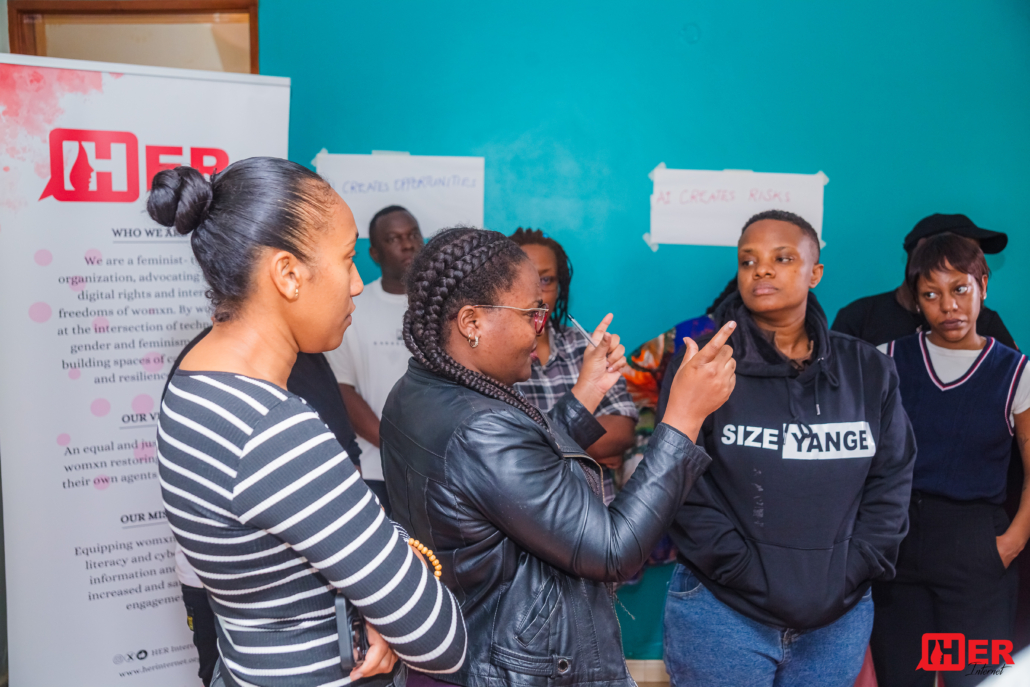
Between promise and caution asked what “feminist AI” means, the room offered a list of values: equity, transparency, accountability, privacy, inclusive representation, and technology that does not discriminate. Then came the question that unsettled the list: is AI really feminist? For womxn running small businesses with little money for a graphic designer, AI has made marketing simpler. It speeds up research, learning and everyday tasks, and it can support livelihoods. One participant described young innovators in northern Uganda using real-time community data to alert poultry farmers, most of them womxn, to disease and heat problems in their sheds. Yet even that story exposed a gap: the system did not capture who actually receives the money when a womxn farmer sells her chickens, a household question that shapes whether she benefits at all. Other participants were wary. The risks, one argued, will outweigh the opportunities if people using these tools are not properly guided, from weaker critical thinking and lost jobs to AI illiteracy, thin data protection and power concentrated in a handful of companies. Several voices pushed the conversation beyond individual choices and countered that users shape how a tool behaves, noting that an AI image generator asked for “feminist caricatures” returned angry womxn, a reflection of what it has been fed.
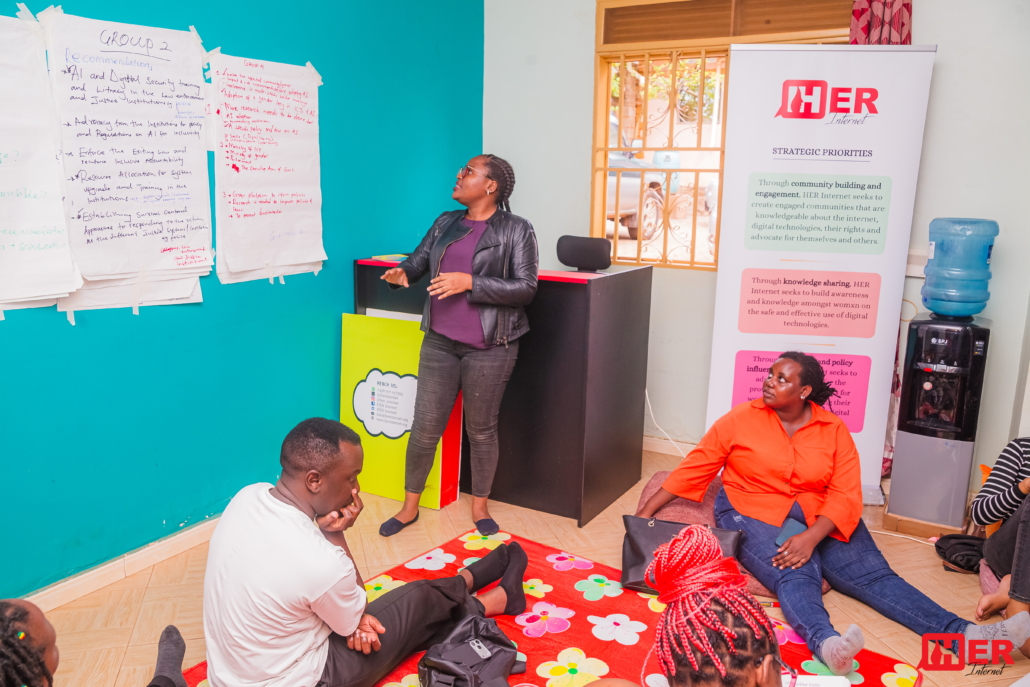
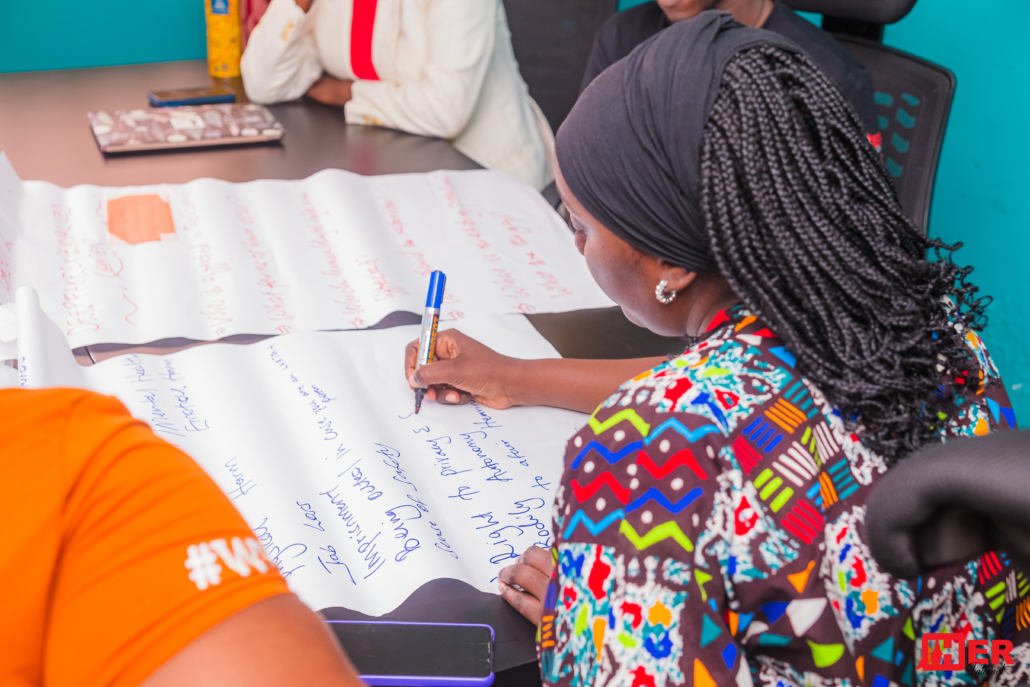
When fear decides who speaks: Groups then worked through five arenas of harm, from surveillance and privacy to deepfakes, mistaken identity in policing, and visibility in advocacy. A pattern ran through all of them. Scrutiny of civil society, the misuse of personal data and the threat of exposure leave womxn afraid to speak, organise or even be seen online. That fear becomes self-censorship, and self-censorship quietly removes womxn from the very conversations that shape their lives. Participants also noted that Uganda has no specific law on consent for the use of a person’s image, so a photo taken from a social platform can be altered and misused with little recourse. Victims are often told to disappear offline, yet the answer, the room agreed, should not be silence but access to every avenue of justice.
When AI errs, through misidentification, missing evidence or leaked private information, the results can be wrongful arrest, mob justice and deeper surveillance. Participants raised the risk of systems trained on stereotypes of what a “criminal” looks like, and noted that masculine-presenting womxn are especially exposed. Because restrictive laws make reporting to the police unsafe, many turn instead to bodies such as the Equal Opportunities Commission and the Uganda Human Rights Commission, and to public interest litigation. Sex workers, womxn with disabilities and womxn in rural areas with limited access to information face blackmail, doxxing, harassment and deepfakes. Participants observed that content moderation works mostly in English, that major platforms have no physical presence in Uganda through which they can be held accountable, and that engagement-driven systems can reward the very accounts that abuse them.
A law that has not caught up: Uganda still has no regulatory law for AI, though a bill is reported to be on its way. Participants listed the protections that exist, including the Article 27 of the Constitution, the Data Protection and Privacy Act and the Computer Misuse Act(2011), and stressed how far they fall short. Cyber laws are applied selectively and enforced weakly, cross-border data transfers go unregulated, and internet shutdowns during politically tense periods sit outside any remedy and make it unsafe for many womxn and their organisations to report abuse at all. Big technology companies add their own gaps. Many have no physical office in Uganda to answer to, content moderation works mostly in English, and Uganda is largely absent from the rooms where these technologies are designed and standards are set.
After lunch, the room physically took sides on whether Uganda needs AI-specific regulation, views split between those who doubted a country struggling with basic implementation was ready, and those who argued that womxn cannot work in a legal vacuum and that even an imperfectly enforced law gives lawyers somewhere to start. Most felt existing laws are insufficient, tech companies should carry greater responsibility, communities most affected should have a formal role in AI governance, and governance must address gender explicitly rather than through blanket clauses. On building the capacity of law enforcement, opinion was sharply divided, with some arguing that in a militarised state the police protect power and property rather than people.
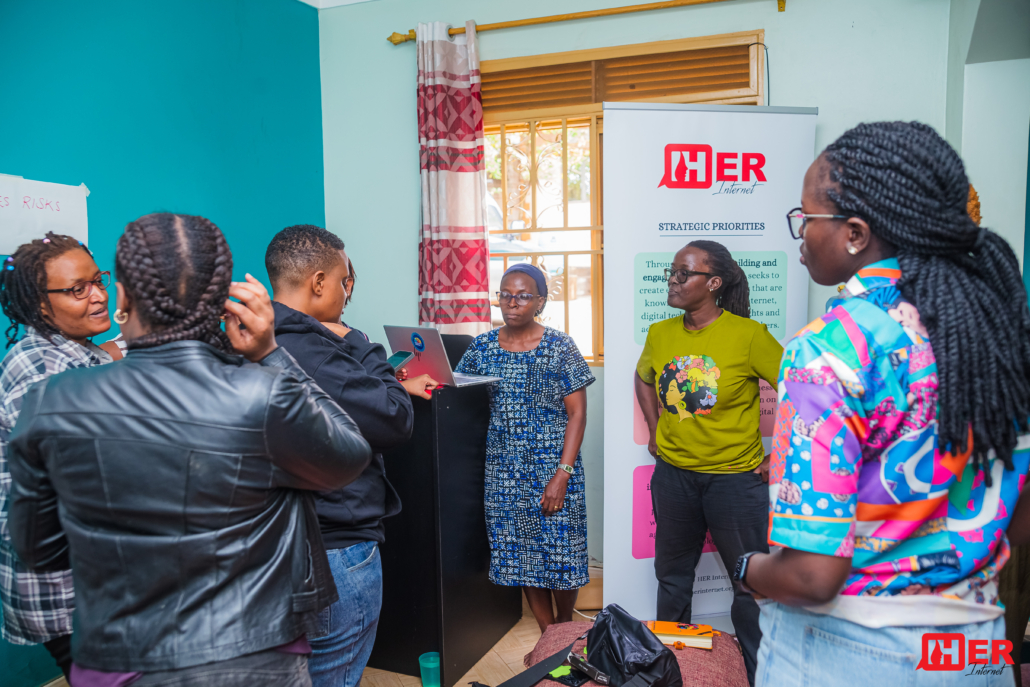
What the room asked for: Groups drafted recommendations for five audiences, each framed around structurally silenced womxn. Funders were asked to send money directly to local organisations, to offer flexible, rapid-response funding, and to resist reporting conditions that could expose grantees. Feminist movements were urged to share research beyond their own circles and to enter policy and platform spaces outside their comfort zones. Justice institutions were asked for training on AI and digital harm and for survivor-centred responses. Government was asked to involve affected communities in drafting AI policy, to require impact assessments before AI is adopted, and to invest in cybersecurity and digital skills. Tech companies were asked to design with a gender lens, to fairly compensate data workers in the global south, and to take real accountability for misuse of data.
HER Internet will bring these voices together in a position paper and share a final draft with everyone. In a country where the law too often treats these womxn as though they do not exist, that choice was the point of the day.